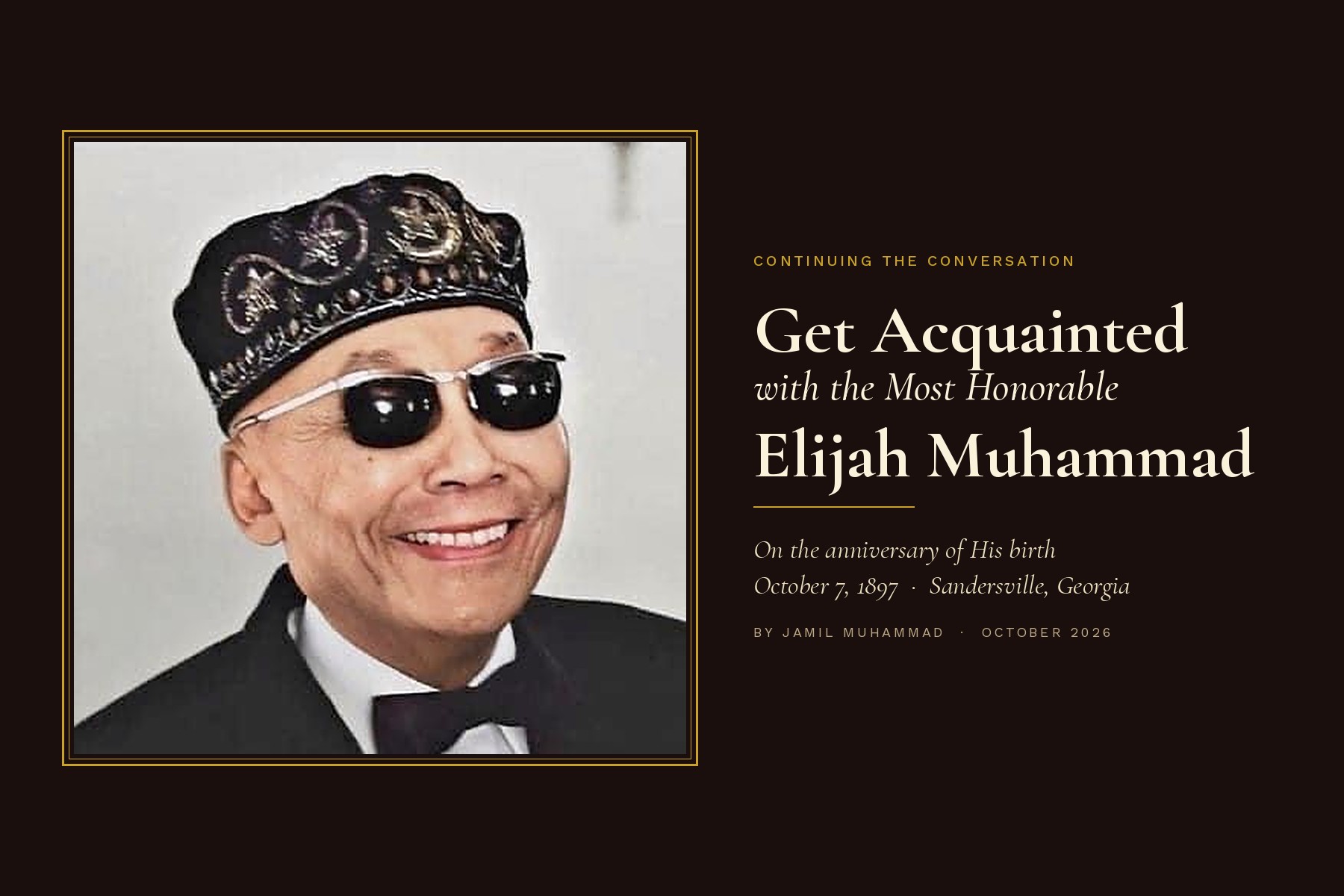
Many people never speak of the greatness of the Most Honorable Elijah Muhammad, yet they acknowledge His students, men and women who contributed significantly to the upliftment and inspiration of Black people. A careful study of history shows that those who labored to lift our people either followed Him, sought His counsel, or studied Him and His program. Measure what was accomplished under His leadership in building a nation within a nation, and no one else comes close.
Even today, His name is rarely mentioned when our history is discussed.
He was born on October 7, 1897, in Sandersville, Georgia. This essay is for those who do not know Him and for those who believe they do. It is an invitation to get acquainted with Him and to revisit and rethink what you have heard or believe that you know.
Where He came from
His birth name was Elijah Poole, and His father was a rural Georgia minister. He had only a third-grade education. Daniel Burley’s foreword to Message to the Blackman in America records that He “learned only the bare rudiments of reading, writing, and arithmetic before he had to go to the fields to help his family earn a living.”
Of the South, He wrote:
“I married and went to Detroit with my two children in 1923,” He wrote (page 311).
In Detroit, He met His teacher, Master Fard Muhammad. “He taught me for three years (night and day) on the histories of the two people, Black and white,” the Messenger wrote in Our Saviour Has Arrived (page 96). Upon the departure of His teacher, He became the Leader, Teacher, and Guide of the Nation of Islam.
What He taught
Asked by the National Educational Television Network in Phoenix, Arizona, to describe His mission, He answered:
The foundation was knowledge of self:
From knowledge of self came a duty to one another:
Then He gave a program: “We must stop relying upon the white man to care for us. We must become an independent people.” Among the twelve steps He listed are these (pages 170–171):
“Make your own neighborhood a decent place to live.”
“Rid yourselves of the lust of wine and drink and learn to love self and your kind before loving others.”
“Build your own homes, schools, hospitals, and factories.”
“Spend your money among yourselves.”
“Build an economic system among yourselves.”
“Protect your women.”
In “An Economic Blueprint” (page 174) He set the terms for working together: “Recognize the necessity for unity and group operation (activities),” “Pool your resources, physically as well as financially,” “Stop wanton criticisms of everything that is black-owned and black-operated,” and “Keep in mind—jealousy destroys from within.” He gave this example: “If there are six or eight Muslims with knowledge and experience of the grocery business—pool your knowledge, open a grocery store—and you work collectively and harmoniously, Allah will bless you with success.”
He taught care of the body. In How to Eat to Live, He wrote: “Begin at once, eat only one meal a day regardless of the work you are doing,” and “Keep any hog or swine out of your foods.”
The Muslim Program opens with What the Muslims Want:
2. We want justice. Equal justice under the law. We want justice applied equally to all, regardless of creed or class or color.
3. We want equality of opportunity. We want equal membership in society with the best in civilized society.”
What He built
The Nation of Islam recorded the work in Accomplishments of the Muslims. Its businesses formed a chain, each supplying the next. Food was grown on Muslim land, hauled on Muslim trucks, packed by Muslim hands, and sold in Muslim stores and restaurants. The savings of Black people went into a bank meant to serve Black people. A newspaper printed on the Nation’s own press carried His words across the country. Schools prepared the next generation to run all of it. In the book’s words: “Each of our businesses compliments the other. There is a relationship between them all. This is how you build.”
It began small. The book records a bakery at 31st Street and Wentworth Avenue in Chicago, and it describes the cleaning business as “one of the first businesses established personally by the Messenger of Allah.” In the 1950s came the Temple No. 2 Grocery Store and Restaurant on 71st Street. In the 1960s came the Temple No. 2 Cleaners on 63rd Street, the Shabazz Grocery and Restaurant, a barbershop, and Temple No. 2 Clothiers. From there:
Land and food. In Michigan, 1,000 acres, with silos holding 100,000 bushels each, an egg operation of 40,000 chickens, a 50-acre apple orchard, and a dairy herd of 100 Holstein cows. In Georgia, 5,000 acres, a beef herd of 800 head, a dairy that milked 200 head at a time, and a cannery that shipped string beans, apples, corn, tomatoes, and okra to the Nation’s restaurants and bakeries in Chicago. The book reports His teaching that “a people cannot exist freely without land,” and adds: “We must remember that without land there is no production.”
Distribution and trade. A fleet of Kenworth tractor-trailers with refrigerated 40-foot trailers, each rated to pull up to 100,000 pounds of freight from coast to coast, along with the Nation’s own airplane for faster delivery. An import store brought in goods from other nations and sold them to our people at fair prices.
Money. A savings bank, which the book describes as His idea from the 1950s, built “to use the savings of Black people to help fight poverty and want among Black people.”
Homes. Apartment units in Chicago housing about 200 families at low rent, open to “followers and non-followers alike,” and new homes built on the South Side.
Schools. More than 40 Muslim schools across the country by the book’s count, beginning with the University of Islam. The book records that “He sacrificed and faced persecution to keep the doors of the first University of Islam open.” He also planned an Islamic University designed to house 10,000 students.
Press. Muhammad Speaks, printed on a four-color web press in a four-story, 60,000-square-foot plant in Chicago that the Nation purchased and renovated in 1968. The book calls it “the largest Black newspaper in North America.”
Health. Plans for a 200-bed hospital. The book records that He said such a hospital “shall always take any patient regardless of race color, creed or nationality.”
In 1959, He traveled to Washington, D.C. Accomplishments of the Muslims records that “before he was unwanted but this time he was treated like a King. He received a Presidential Escort throughout the city. No Black man of this country or white man that we know of has received such great honor.”
What His teaching made of people
People often limit His work to reforming the fallen, and He did that. Burley wrote that He “goes among the fallen of his people and redeems the wino, the alcoholic, the narcotics addict, the prostitute, the sidewalk hoodlum, the thief and the profane.” Most of those who followed Him, though, were already law-abiding, hard-working men and women. They were teachers, nurses, mechanics, veterans, small business owners, and students who found in His teachings a new direction, a higher purpose, and a stronger community.
Burley recorded what a visitor found in His mosques: “Calm, quiet, self-contained efficiency and pride is seen on every hand.” The Messenger, he wrote, “lifts up Negro women” and “makes it mandatory that his male followers honor their own women as individual examples of virtue.” In the University of Islam, he observed, “children in the third grade are speaking Arabic fluently and working difficult problems in Algebra!” And the Messenger, he wrote, “gives the little Negro true leadership,” reaching the poor whom most organizations of the day ignored.
Those who learned from Him
Malcolm X began corresponding with Him from prison in 1948 and became His student and one of His ministers.
Muhammad Ali received his name from Him on March 6, 1964, and the stand that made Ali known around the world beyond the ring came from His teachings. On April 28, 1967, Ali refused induction into the United States Army. His written statement read: “I refuse to be inducted into the Armed Forces of the United States because I claim to be exempt as a minister of the religion of Islam.” Ali was stripped of his title and barred from boxing for three years. At his hearing, he testified that he was “sincere in every bit of what the Holy Qur’an and the teachings of the Honorable Elijah Muhammad tell us.” In 1971, the Supreme Court overturned his conviction without dissent. Justice William O. Douglas wrote that Ali’s “basic objection was based on the teachings of his religion.”
Minister Louis Farrakhan, His student, served as minister in Boston and in Harlem and as His National Representative, a title he carries to this day.
Others sought Him out. In February 1966, Dr. Martin Luther King Jr. and Coretta Scott King met with Him at His home in Chicago. That August, Stokely Carmichael, later known as Kwame Ture, met with Him there as well. Among entertainers, the soul singer Joe Tex joined the Nation of Islam and later left show business to lecture. Dick Gregory spoke publicly of the power of His teachings. James Brown, in a recorded message to Black listeners, told them, “Like Mr. Muhammad said, do for yourself.”
Why every one of us owes Him Remembrance
The Most Honorable Elijah Muhammad deserves the respect and remembrance of every Black man, woman, and child, regardless of religious belief, political persuasion, or economic status.
He addressed the whole condition of His people: what they ate, where they lived, how they earned, where their money went, what their children learned, how men treated women, and what a people must know about itself to stand up. Those needs do not belong to one faith or one party or one income. The housing built under His leadership was open to people who did not follow Him. The hospital He planned was for any patient.
On His birthday, we ask you to read Message to the Blackman in America. Weigh His words against what you have been told about Him. Look at what was built. Burley closed his foreword with these words: