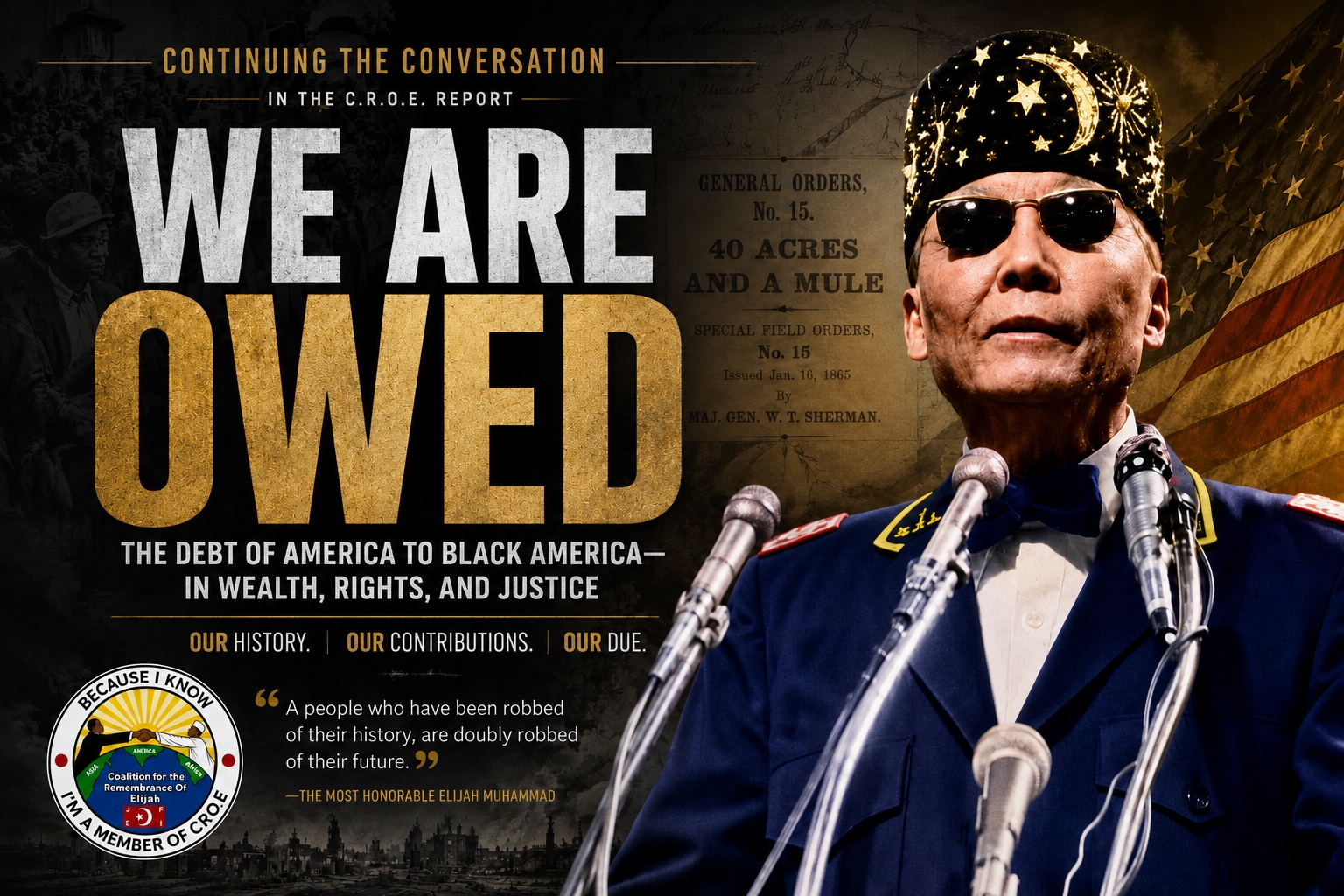
Black people in America have placed their confidence in the American political system for two hundred and fifty years. The Republican Party has held that confidence at times. The Democratic Party has held it more often. Through every shift in which party we trusted, the harder question is: has the system itself ever actually delivered on a single one of its foundational promises to us? The Most Honorable Elijah Muhammad answered that question sixty years ago, in writing, on the record. His answer has been ignored. The evidence of the last two hundred and fifty years has only confirmed it.
For sixty years, Black people have been instructed to hold up the Civil Rights Act of 1964 as the proof — the fulfillment, the receipt. The Act's passage was paid for in blood. The marchers beaten at the Edmund Pettus Bridge. The children hosed in Birmingham. The four little girls killed in the 16th Street Baptist Church. That courage is unquestioned. But the courage of those who fought for the Act is one question. What the Act, and the political system that passed it, has actually delivered in the sixty years since is a separate question entirely. The conflation of the two is how an honest accounting has been avoided for three generations.
The Most Honorable Elijah Muhammad refused that conflation while the Act was still being debated. In Message to the Blackman in America, published in 1965 — within months of the Act's passage — He wrote:
He did not write that out of bitterness. He wrote it as a forecast. And in Our Saviour Has Arrived, He stated the underlying principle in eleven words:
Sixty years of evidence now sits on the table to be measured against those two sentences.
If the Civil Rights Act of 1964, the Voting Rights Act of 1965, and the Fair Housing Act of 1968 were the deliverables of the modern political system to us, then six decades of measured economic outcomes constitute the audited financial statement of that delivery. Place the numbers from the era of the Acts beside the numbers of today and the trajectory speaks for itself. In 1960, the average wealth ratio between white and Black households stood at approximately 8 to 1. In 1970, two years after the Fair Housing Act, the Black homeownership rate stood at 41.6 percent against 65.2 percent for white households — a gap of 23.6 percentage points.
Sixty years later, the gap has not closed. It has widened. For every dollar of wealth held by a white family, a Black family today holds approximately thirteen cents. The median white household holds approximately $184,000 in wealth. The median Black household holds less than $23,000. Between 2019 and 2022, the mean gap in net worth between Black and white households grew from $841,900 to $1.15 million — a thirty-eight percent increase in three years. A Black college graduate today holds less wealth than a white household headed by someone with only a high school diploma. The Black homeownership rate sits at 44 percent against 73.2 percent for white Americans — a gap of 29.2 percentage points, wider than it was in 1970. Closing the racial wealth gap would require a transfer of as much as $10.7 trillion.
The Civil Rights Act passed in 1964. It is now 2026. The gap is wider. The promise has not been delivered. It has been measured, every year, and it has been allowed to stand. The Most Honorable Elijah Muhammad named the reason before the gap had been formally measured:
The pattern is older than the Civil Rights Act. The pattern is consistent: the promise is made, the enforcement is dismantled, the promise becomes paper. In January 1865, General William Tecumseh Sherman issued Special Field Order No. 15, redistributing 400,000 acres of confiscated Confederate land to formerly enslaved families in plots of up to forty acres. A follow-on order from General Rufus Saxton added the loan of an Army mule to break the soil. This is where the phrase "forty acres and a mule" comes from — not a slogan, but a federal promise issued in writing, on military letterhead, to people the United States had just freed from bondage. By June of 1865, 40,000 freed people had received land titles. They built homes. They governed themselves on land they owned. By year's end, President Andrew Johnson — a man who had owned enslaved people — rescinded the order and returned every acre to the same Confederate slaveholders from whom it had been taken. The value of what was taken in that single act has been estimated at $640 billion in today's dollars.
One hundred and forty-eight years later, the pattern repeated itself in different clothing. On June 25, 2013, in a 5-4 decision in Shelby County v. Holder, the United States Supreme Court struck down the coverage formula of the Voting Rights Act of 1965. The Court did not repeal the Act. It destroyed the mechanism that made the Act's most powerful enforcement provision — Section 5, the preclearance requirement — operative. Under Section 5, states and counties with documented histories of racial voter suppression had been required, since 1965, to obtain federal approval before changing any voting law. For nearly fifty years, this had been the most effective civil rights enforcement mechanism in American history. It stopped discriminatory voting changes before they could take effect. The Court invited Congress to write a new coverage formula. Twelve years have passed. Democratic majorities have come and gone. Republican majorities have come and gone. The Obama administration, the Trump administration, the Biden administration, and the Trump administration again have each had their turn. No new formula has been written. Section 5 sits on the books today, intact in its language and inoperative in its effect — a weapon with no trigger. How important is the enforcement of the Voting Rights Act, to the institution that passed it, when that institution has had twelve years to restore what was taken down and has not lifted a finger to do so? What Andrew Johnson did in 1865, the Supreme Court did in 2013, and Congress has confirmed in every year since. One hundred and forty-eight years apart. Same pattern. Same result.
Consider the most quietly damning example of this pattern, and the only one we have made into a federal holiday. I question Juneteenth, as we now celebrate it. The Emancipation Proclamation was issued on January 1, 1863. General Order No. 3 reached Galveston, Texas on June 19, 1865 — two and a half years later. For thirty additional months after they had been legally freed, the enslaved people of Texas were held in bondage because the federal government did not enforce the order it had already issued. That day, June 19, is now Juneteenth — a federal holiday signed into law in 2021. The original emancipation date was never made a federal holiday. The country did not commemorate the proclamation itself for 158 years. What was made into a holiday was the date the federal government's own delay was finally corrected — a federal acknowledgment of its own failure, repackaged as a celebration of Black freedom. The deeper question is this. Why would a people celebrate the day that someone else gave them their freedom? Every other people on earth that achieved liberation commemorates what they took. We commemorate what was finally handed to us, on a timeline chosen by the same people who had enslaved us, by the same government that had withheld the order it had already issued. That is not liberation. That is permission.
The pattern is not confined to land, to voting rights, or to the delayed delivery of freedom itself. It is the through-line of the entire 250-year record. The Fourteenth Amendment guaranteed equal protection. The Fifteenth Amendment guaranteed the vote could not be denied on account of race. Both were nullified for the better part of a century — not by repeal, but by non-enforcement. Poll taxes, literacy tests, white primaries, and naked violence stripped Black citizens of the rights both amendments guaranteed on paper. The federal government, with the constitutional authority to intervene, declined to. Between 1877 and 1950, nearly 4,000 Black people were lynched on American soil, the vast majority without federal prosecution. A federal anti-lynching bill was introduced in Congress for the first time in 1900 and was defeated, filibustered, or quietly killed approximately two hundred times across one hundred and twenty-two years. It was not until March 2022 — sixty-seven years after Emmett Till was tortured and murdered in Mississippi — that the United States finally enacted a federal law making lynching a hate crime. One hundred and twenty-two years.
In late May and early June of 1921, the prosperous Black community of Greenwood in Tulsa, Oklahoma — known as Black Wall Street — was attacked by armed white mobs that included as many as 10,000 men, some deputized by city officials and operating alongside the Tulsa Police and the National Guard. Thirty-five city blocks were burned. As many as 300 Black residents were killed. Roughly 10,000 Black Tulsans were left homeless. In January 2025 — one hundred and four years after the attack — the United States Department of Justice issued its first official federal accounting. The DOJ's Civil Rights Division concluded that what happened in Tulsa was "a coordinated, military-style attack," that "no perpetrator was ever held accountable, then or now," and that victims were "never compensated for the loss of their homes or businesses." The report carried no prosecutions and no compensation. The same pattern accounts for Rosewood, East St. Louis, the Red Summer of 1919, and dozens of other documented attacks on Black communities by white mobs. The system did not lack the authority to intervene. It lacked the will. The absence of will, repeated across a century and a half, is not an oversight. It is a policy.
The Most Honorable Elijah Muhammad named the cause of the resulting anger in Our Saviour Has Arrived:
Not the lack of laws. Not the lack of speeches. Not the lack of commissioned reports. The lack of justice. Every massacre unprosecuted, every land claim unhonored, every lynching unanswered — each one a separate withholding, each one documented today in the wealth gap and the carceral record. The Civil Rights Act did not pay the debt for the 4,000 lynchings, for Tulsa, for the forty thousand families whose land was taken back, for the redlining that engineered the wealth gap, for the federal exclusion of Black agricultural and domestic workers from Social Security, or for the systematic denial of Black veterans' access to the GI Bill — the largest wealth-creation program in American history. None of these debts has ever been paid. None has even been formally acknowledged in a manner that carries the force of law.
The Most Honorable Elijah Muhammad saw all of this clearly. He distinguished between civil rights — which He characterized as a domestic permission slip from the same power that withheld it — and the recognition of Black people as a sovereign nation entitled to the same standing as any other people on the earth. In Message to the Blackman in America, He addressed the slave-master directly:
His use of the term human rights was not an endorsement of any international legal framework as the remedy. It was the rightful comparison — the language the rest of the world would recognize — used to expose the inadequacy of what we were being offered. His solution was not a Western legal one. His solution was divine: separation, land of our own, and self-government, as outlined in What the Muslims Want.
Still, the comparison He drew is worth measuring. If our case was, in fact, a matter of human standing rather than domestic legal status, has the higher arena — the international community, the United Nations — in the sixty years since, delivered anything closer to accountability than the domestic one has?
In 2001, the United Nations convened the World Conference Against Racism in Durban. The Durban Declaration acknowledged that slavery and the transatlantic slave trade were crimes against humanity. In 2016, the United Nations Working Group of Experts on People of African Descent issued a formal report on its mission to the United States. The report explicitly called for the United States to consider reparations for Black people. In 2021, in the aftermath of the murder of George Floyd, the UN Human Rights Council adopted a resolution calling for accountability and reparatory measures. In 2022, the United Nations established the Permanent Forum on People of African Descent — a standing body specifically tasked with addressing the legacy of slavery and ongoing racial injustice. Each of these proceedings has produced what such proceedings produce. Declarations. Recommendations. Reports. Calls. Frameworks. Not one of them has produced a single binding consequence for the United States of America. No enforcement action. No sanction. No reparations payment. No transfer of any kind. The higher court the Most Honorable Elijah Muhammad identified has rendered its verdict, year after year, in language as careful as any verdict could be — and the verdict, for all practical purposes, is the same one the lower court rendered. Noted. Unpaid. Unenforced.
This is the result the Most Honorable Elijah Muhammad predicted. He understood that no political system — foreign or domestic — would ever do for Black people the work that Black people had not first done for themselves. He stated it this way:
I write this from a particular standing. I have worked closely with, and in the political system, and I serve within it still. The work I do day to day is the work of trying to move a system that does not move easily, on behalf of people the system does not serve easily.
The American political system is not our salvation. Our salvation is the work we do for ourselves. The system is, at best, a limited tool we can use to win incremental gains while the real work proceeds elsewhere — in our institutions, in our economy, in our unity, in the production we have not yet built. The system is a component. It is not the engine.
I have watched what the system delivers when we treat it as the engine of our liberation. I have also watched what we surrender when we accept that framing. The leadership splits. The principle splits. The unity that the moment demanded gets traded for the access that the moment offered. The crumb does not look like a crumb in the room. It looks like progress.
If even those of us inside the system understand what the system cannot deliver, the harder question is the one we owe ourselves. What have we done with the years spent waiting on a debt that was never going to be paid? In the 2020 presidential election, Black voter turnout was 62.6 percent — below the 2008 peak of approximately 65 percent and well below the white voter turnout of 70.9 percent. In 2024, the Black-white turnout gap widened further, returning to a margin not seen since the 1990s. Only 27 percent of Black adult citizens voted in all three of the most recent national elections — 2020, 2022, and 2024 — compared to 48 percent of white adult citizens. At the federal level, the numbers tell one story. At the local level — where the police are funded, the schools run, the prosecutors chosen, the housing zoned — the numbers tell a worse one. In the 2023 Chicago mayoral runoff that elected Brandon Johnson, total citywide turnout was approximately 35 percent. The pattern is national. Across Detroit (80 percent Black), Baltimore (60 percent), Jackson (80 percent), Memphis, Birmingham, and New Orleans, municipal turnout collapses to a fraction of what it is in the national elections that shape Black life least.
This is not a statement about insufficient numbers. Blacks are 14 percent of the national population, 28 percent of Chicago, the plurality or the majority in dozens of major American cities. The Most Honorable Elijah Muhammad's diagnosis was not that we lacked the population. His diagnosis was that we lacked the unity to act on the population we have:
The data does not indict the numbers. The data indicts the unity. We have been fighting each other for crumbs. Crumbs of political access. Crumbs of representation. Crumbs of party loyalty. Crumbs of cultural validation. We have argued — bitterly, publicly, generation against generation, class against class — over which crumb is the better crumb. While we have been arguing, the table itself has been cleared. This is the second indictment, and it lives alongside the first. The first indictment is the system's. The second is ours. Both are real. Neither cancels the other.
The Most Honorable Elijah Muhammad outlined a concrete program, ten points strong, which He named What the Muslims Want. Full freedom. Equal justice. Equality of opportunity. A separate state or territory. An end to police brutality. Equal education taught by our own teachers. He insisted the program be put before Congress, and He named the trap before we walked into it. He wrote in Our Saviour Has Arrived:
The master will not tell the truth. The master has never told the truth.
He laid out an economic blueprint:
Unity. Pooling resources. Producing. Owning. Building. Stopping the internal criticism that hollows out every Black institution before it can mature. He told us to build.
The Civil Rights Act, measured against the wealth gap it was supposed to close, has not delivered. The Voting Rights Act, measured against the enforcement mechanism the Supreme Court withdrew and Congress has not restored, has not delivered. The Fourteenth and Fifteenth Amendments, measured against a century of non-enforcement, did not deliver. Sherman's order, measured against Andrew Johnson's reversal, did not deliver. The Emmett Till Antilynching Act delivered a milestone for the calendar and nothing for the dead. The 2025 DOJ report on the Tulsa Race Massacre delivered an acknowledgment and not a single dollar of restitution. The international appeal has rendered the same verdict. Durban. The Working Group reports. The Permanent Forum. Each one a declaration. None of them a payment. The political system was never going to deliver. The Most Honorable Elijah Muhammad said so. The record proves Him right. The years spent waiting on a debt that was never going to be paid have been years our children will not get back.
So the question I'm leaving with the reader is the one the Most Honorable Elijah Muhammad asked from the beginning: What are we doing for self? Not what is the party doing. Not what is the court doing. Not what is the United Nations doing. Not what is the next administration promising. What are we doing? What are we building? What land, what production, what schools, what unity of purpose are we leaving for our children's children's children? We are owed. The work we owe ourselves is the only payment that has ever been coming.