Like many Black men, I have faced health challenges linked to hypertension. We all know the solutions — a proper diet, exercise, managing stress, and when necessary, the proper medications. I have known the healthiest way to eat for most of my life, taught directly from the Honorable Elijah Muhammad's book How to Eat to Live. I understood, like so many others understand, exactly what I should be doing.
I was not consistent. Not in eating properly. Not in exercising. Not in following medical instructions. Those choices produced a medical emergency that put me in the back of an ambulance and in a hospital bed for several days. I was able to return home. Many others have not been as fortunate.
I knew the truth. I knew the discipline required to preserve my own life. Yet I still chose what felt easy at times, and I paid the price. There is no truer example of choosing the easy path over the necessary one. I should have chosen truth over convenience. We must begin to choose truth over convenience.
That is the conversation this column intends to have. Not only about the small disciplines of our individual lives, but about every public conversation we are being asked to have about our condition as a people. Because the same trade I made in private — knowing the truth and choosing the convenient path anyway — is the trade being made openly in our values and beliefs, in our politics, our media, our communities, and our leadership. And it is costing us far more as a people.
What this column is.
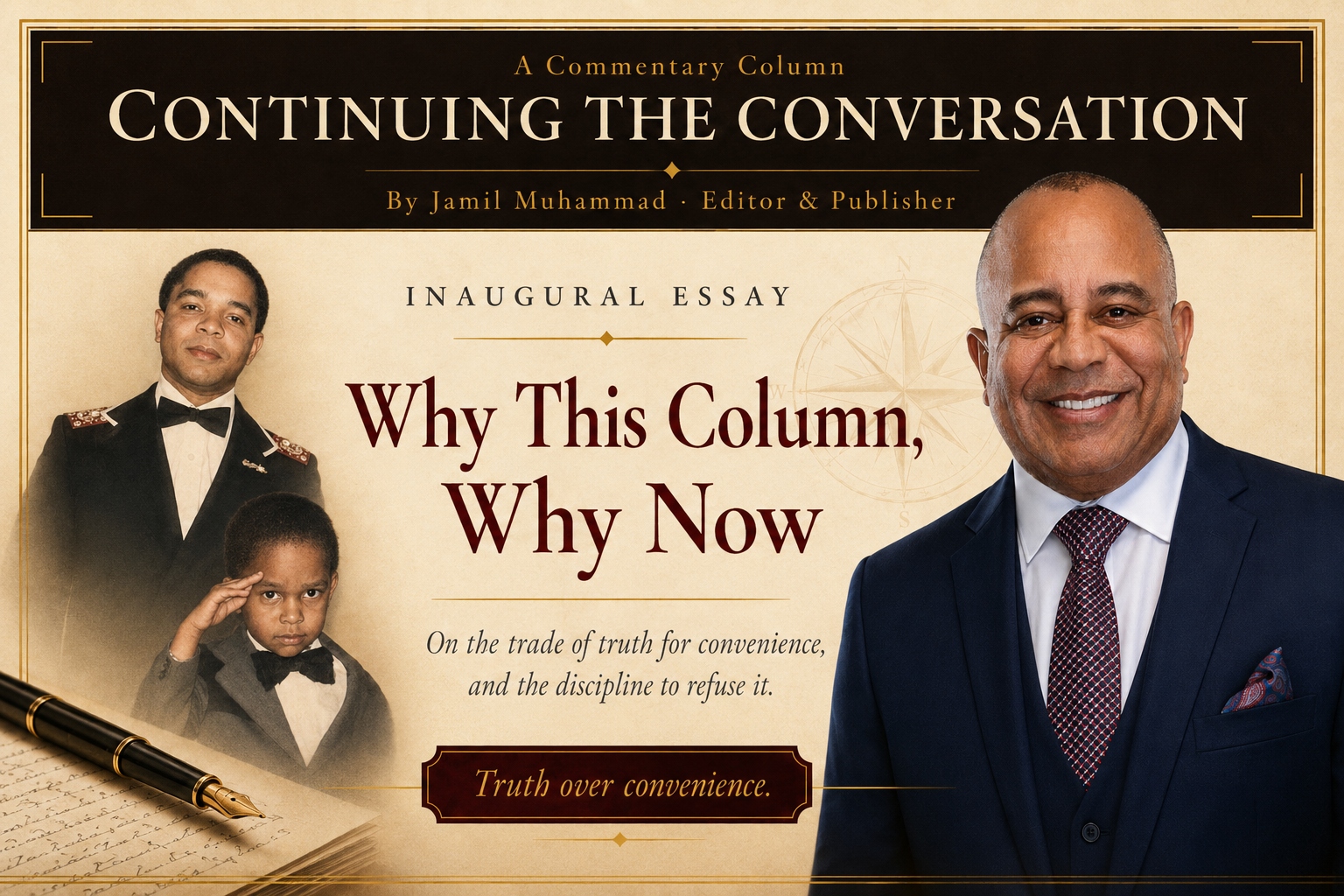
Continuing the Conversation is a recurring commentary column on The C.R.O.E. Report. Its premise is plain: truth over convenience. The questions that lead to root causes. The work of holding to that premise is not.
The discipline is to refuse the trade that almost every news outlet, every information source, and every public conversation has already made — the trade of what is true for what is convenient. Convenience tells us the blame is always somewhere else. Convenience tells us the question being asked is the right one. Convenience tells us the surface story is the full story and the promise has been kept. Convenience is comfortable, and it has cost us — credibility, clarity, and a people's ability to see itself clearly.
This column is the editorial refusal of that trade. It will take live stories and pursue the questions the convenient narrative would prefer not be asked. It will take promises that were made and hold them against the record of what actually happened. The premise of the work is single: we cannot change our condition unless we change our way of thinking, so teaches the Honorable Elijah Muhammad. That begins with our willingness to ask better questions, think critically, and measure honestly what we have already been given and what we have chosen.
What this column is not.
It is not a repackaging of The C.R.O.E. Report. The newsletter retains its work — including its treatment of His verbatim writings — and this column does its own. The two publications are companions. Neither replaces the other.
It is not commentary as entertainment, and it is not commentary written for the contrarian, the reader without conscience, or the credentialed elitist who treats the teachings of the Messenger — and the Black community as a whole — as beneath them. The Honorable Elijah Muhammad teaches that the man without conscience cannot be taught. I have written this column for readers who have one.
The legacy it continues.
My father, Munir Muhammad, used to tell me, "I'm trying to save you some time." He said it often, in many contexts, and what he meant was that he had traveled the road already, had paid for the lessons already, and was offering me the receipts so I would not have to pay for them again myself. He understood time as the only resource we cannot negotiate for more of.
Once, when I was younger, I found myself in a compromising situation. I had been misled and manipulated, and I walked into the conversation with my father convinced that the cause sat with everyone else. He made me trace every step. Every choice. Every place I had assumed instead of asked. Every place I had ignored my instincts, to go along with the group. By the time we reached the end of that conversation I understood that the blame did not belong to anyone else. It belonged to me. He taught me that the people who revise history for their own convenience, to justify their decisions, never learn from the experience. He taught me that excuses are only good for the people who are saying them.
That is the discipline I am extending into this column. Not as nostalgia, but as method. Continuing the Conversation exists because my father taught me that surface answers are insults to serious questions, and because the work of C.R.O.E. — the Coalition for the Remembrance of Elijah — has always been the work of refusing the convenient narratives about the Most Honorable Elijah Muhammad. C.R.O.E. is the organization that upholds His name exclusively. It does so because His teachings, His program, and His works not only created a Nation within a Nation — they restored Black men and women to self-respect. That work was given for all of Black America, and the responsibility to remember it belongs to all of us.
I cannot occupy my father's space, and he knew that. He told me once that he hated he would not be here to see me at my best, because he understood that the best of me would only emerge in ground he had not stood on himself. C.R.O.E. was his life's work and his love, and the love of a thing you have created is a love that can only be understood by those who have created something. My contribution is not to replicate his work. My contribution is to extend the foundation he laid — with the strengths I have been given, and the experience I have earned — and to do so without disturbing the authenticity that he and the co-founders, Shahid Muslim and Halif Muhammad, established in the organization from the beginning.
This column is part of that contribution.
The principles that ground the work.
At the core, the Most Honorable Elijah Muhammad teaches the truth about the knowledge of God, the knowledge of Self, and the knowledge of the Devil. From that foundation, His teachings extend to every part of a way of life. The principles this column will most often return to are five: truth, unity, self-development, independence, and love of self and kind. Every piece this column publishes will, in the end, sit beneath one of these.
I want to be plain about a question this column is going to ask of its own readers, because the column will lose its right to ask anything else if it cannot first ask this:
Many Black families who are not Catholic send their children to Catholic schools because they believe it will be better for them. We do not treat that as a betrayal of our identity. We treat it as a serious decision made in service of a serious outcome.
Then why would we refuse to even examine the program of the Most Honorable Elijah Muhammad — a program that, in our own lifetime, produced the very institutions we are still asking for today — because of His faith? Is it not as discriminatory to dismiss His accomplishments and solutions because of His faith as it is for others to dismiss us because of who we are? We are asking you to evaluate His program against its results, and to weigh what He built against what we have built since. Regardless of our religious affiliation, our political persuasion, or our economic status, we are all Black people in the same condition. This column will not pretend otherwise.
That condition, plainly named: we are not treated as equals, and no level of personal accomplishment has changed that fact at scale. The most accomplished among us know it. The least accomplished among us know it. The convenient story is that more proximity, more credentials, more acceptance will close the gap. Continuing the Conversation is not interested in the convenient story. It is interested in the difference between acceptance and equality, and in what a self-respecting people would actually do if they understood that difference plainly.
What readers can expect.
I am writing this column for three readers in particular. For young adults who grew up in Islam, were taught the teachings as children, and are now working out what it means to live them — not as inheritance, but as conviction. For elders who have watched our community drift from the substantive progress of an earlier era, and who are hungry to be reminded of a time when progress and Black people could be said in the same sentence without translation. And for readers who have only ever encountered narratives about the Most Honorable Elijah Muhammad — never the Messenger Himself — and who are willing, perhaps for the first time, to look at His program with the same seriousness they would extend to any other.
If you are one of those readers, this column is for you. If you would like to participate beyond reading it, you can. Subscribe to The C.R.O.E. Report.
We have become more focused on defending our opinions than on gathering facts and seeking truth. The truth testifies either for or against us. Regardless, we must seek it.
What is the duty of the Civilized Man?