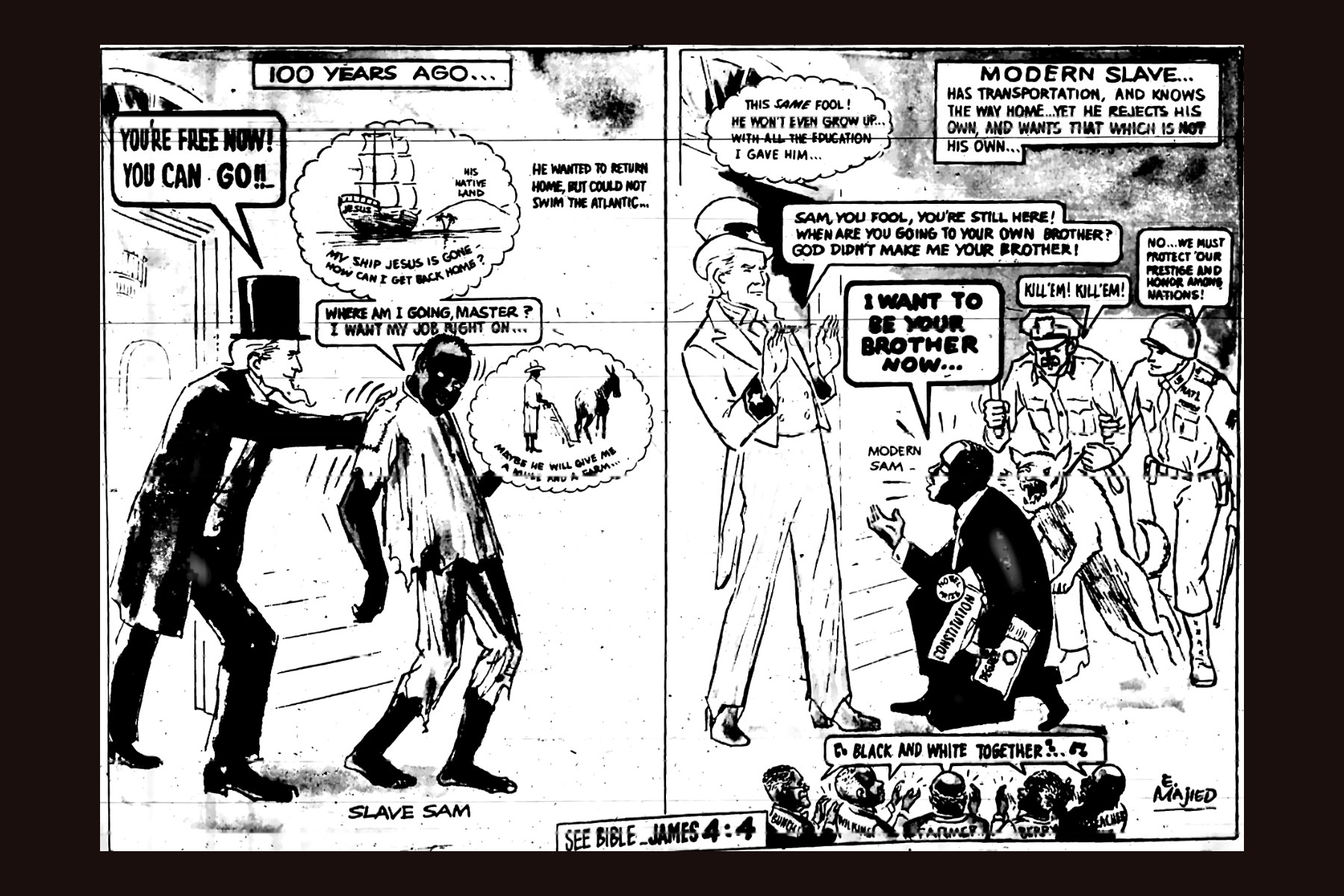
On April 9, 1965, Muhammad Speaks published a two-panel editorial cartoon by its staff cartoonist, Eugene Majied. It ran one month after the march at Selma and four months before President Johnson signed the Voting Rights Act. The cartoon is reproduced above.
The left panel is dated “100 Years Ago.” A slave master tells a barefoot man labeled Slave Sam, “You’re free now! You can go!” Slave Sam answers, “Where am I going, master? I want my job right on...” A caption reads, “He wanted to return home, but could not swim the Atlantic.”
The right panel is dated “Modern Slave...” Its caption reads, “Has transportation, and knows the way home... yet he rejects his own, and wants that which is not his own...” A man in a suit, labeled Modern Sam, kneels before Uncle Sam holding papers marked Constitution and Police. He says, “I want to be your brother now...” Uncle Sam answers, “Sam, you fool, you’re still here! When are you going to your own brother? God didn’t make me your brother!” Along the bottom, five heads sing “Black and white together.” Four are labeled Bunche, Wilkins, Farmer and Berry. The fifth is labeled Preacher. At the bottom center Majied printed one citation: See Bible — James 4:4.
What Majied cited
The two panels make a single comparison. In 1865 the freed man had no means of leaving. In 1965 his descendant had education, transportation and knowledge of where he came from, and was still asking to stay. Majied did not explain the choice in words. He cited a verse. James 4:4 reads:
The cartoon’s position matches the published program of the Most Honorable Elijah Muhammad, which Muhammad Speaks carried as a standing feature and which closes the October 2026 issue on page 16. Point four of What the Muslims Want calls for our people “to be allowed to establish a separate state or territory of their own — either on this continent or elsewhere.” Point nine of What the Muslims Believe addresses integration directly:
The four men drawn at the bottom of the cartoon represented the opposite position. Ralph Bunche, a United Nations official, won the 1950 Nobel Peace Prize for negotiating the 1949 armistice agreements between Israel and its neighbors. Roy Wilkins led the NAACP from 1955 to 1977. James Farmer, as national director of the Congress of Racial Equality, organized the 1961 Freedom Rides. Edwin C. Berry directed the Chicago Urban League from 1956 to 1972, in the city where the Nation of Islam kept its national headquarters. Their program was access to the ballot, to schools, to employment and to public office, secured through law and political alliance.
The record since 1965
Bunche died in 1971, Wilkins in 1981, Berry in 1987 and Farmer in 1999. The organizations they led still operate, and their program became the standard approach of Black political life. Sixty-one years is long enough to measure it.
Some of what it sought was won. The Voting Rights Act passed in 1965. In 2013, in Shelby County v. Holder, the Supreme Court struck down the formula that determined which jurisdictions needed federal approval before changing their voting rules. Barack Obama served two terms as president, and Kamala Harris later served as vice president. This year eleven Fortune 500 companies are led by Black chief executives, which Fortune reports is a record. Eleven is two percent of the list.
The material measures moved far less. The Federal Reserve’s 2022 Survey of Consumer Finances found that the typical white family held about six times the wealth of the typical Black family. The Urban Institute, working from survey data back to 1963, reports that the racial wealth gap has not closed over that period. On schools, the UCLA Civil Rights Project reported in 2024 that integration of Black students peaked in the 1980s, and that resegregation has continued steadily since a 1991 Supreme Court decision allowed districts to end court-ordered desegregation.
Supporters of the integration program say the problem is implementation: the laws exist but are weakly enforced, and the representation exists but lacks power. That explanation has been offered for six decades. A program that has run this long, with this much institutional support, should be judged by its results for the people it was meant to serve.
What the Messenger prescribed
Majied’s Modern Sam is not shut out. He holds the Constitution, he is educated, and he has the means to travel. The cartoon criticizes what he is asking for and whom he is asking.
The program of the Most Honorable Elijah Muhammad did not ask the government for acceptance. It called for land of our own and for a people who produce for themselves and govern their own affairs. On education, point nine of What the Muslims Want states, “We want all black children educated, taught and trained by their own teachers.”
He stated the reason in Message to the Blackman in America, in the chapter “Of Land And A Nation” (page 223):
Majied’s criticism was aimed at the strategy. Bunche, Wilkins, Farmer and Berry each gave decades of work to it, and the cartoon names them because they were its most prominent leaders in 1965.
The same strategy continues under new names. Diversity programs ask corporations for seats. Reparations proposals ask Congress for payment. Police reform commissions ask the state to change how it treats our neighborhoods. Representation campaigns ask the political parties to run more Black candidates. Each one asks the same institutions for standing, which is the request Modern Sam makes in the right panel.
Majied’s question in 1965 was whether a people with the means to build for themselves would keep asking to be admitted. The results of the sixty-one years since are documented and available to anyone who wants to check them. The program the Most Honorable Elijah Muhammad set out as the alternative is printed in full on page 16 of the October 2026 issue. After sixty-one years of the integration program, isn’t it time we commit to working the Messenger’s program?